Header

Header

Tuesday, October 18, 2022

Darter in Palawan Passage - "The Dangerous Ground"


The area of the South China Sea off the coast of Mindanao, between Brunei Bay and Palawan Island is named the Balabac Strait, otherwise known as the Palawan Passage. On nautical charts during the war, this was referred to as the Dangerous Ground. This is where the USS Darter found herself on her fourth war patrol as she lay in wait for the Japanese fleet to arrive, the week of October 20th in 1944 .


Photocopy of a nautical chart of the Philippines, including known seafloor depths and currents

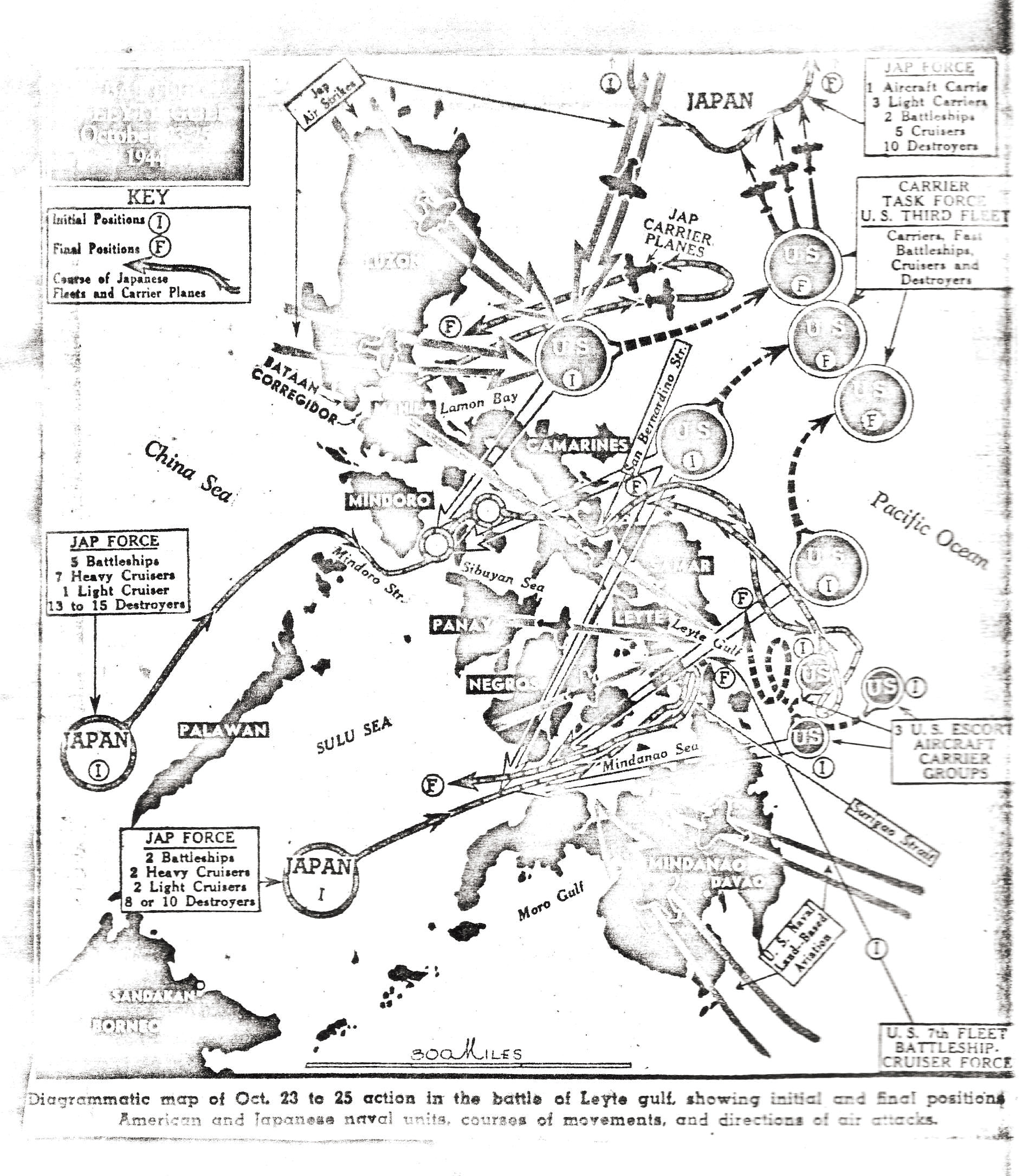
Overview of the Leyte Gulf area showing US and Japan strike forces on October 23-25, 1944.

This was not a frequented area of the South China Sea due to its many hazards. The only nautical charts of this region were British, and they looked so antiquated the Darter & Dace navigators wondered if they were from the turn of the century. (They probably were; likely the ones used by the Royal Navy when they blockaded the Phillippines during the Boxer Rebellion some fifty years earlier).

All these islands in the Philippines had offshore reefs, sandbars and outcroppings of sharp rocks, with breakers up to twelve miles from the shore. The rocks were easily misidentified as ships from a distance, because of the 'wakes' they left when waves broke over them. Many of the area's obstacles to surface boats could not be seen from the air, as they were submerged beneath choppy waves. Accurate depth soundings had never been taken in many areas. The reefs and rocks caused unpredictable currents. Tropical storms, typhoons and rain squalls had been known to blow up without warning, all of which spelled doom for many ships.

Even submerged, the thin and highly maneuverable subs were not safe. Huge coral reefs of irregular shapes also filled the area, some just below the surface, and radar at the time only detected moving objects, not stationary ones. All these factors made sea travel through this area very perilous.
Grandpa's hand drawn map of the region with latitude and longitude lines helped me locate the final resting place of the Darter on satellite images that I will repost later.

Wednesday, October 12, 2022

Hugh's Service Log 10-12-1944


Service log 1O/12/44: "Attacked a large convoy, but could not get in position to fire correctly. Finally had to fire long range shots. Fired four fish and believed to have gotten four hits, each on different ships, the firing was over 6,000 yards. Considering the distance, this was good shooting. Received seven aerial bombs, but continued to chase the convoy for another day, but finally gave up. Found out that we sank one ship, and damaged the other two." - From Hugh's typewritten service diaries

I imagine it looked sort of like the painting he kept in his living room.


Monday, October 3, 2022

10-3-1944 - Darter Under Friendly Fire

On Darter's 4th and final war patrol, one notable incident in the first week of October was on 10/3/44 around 1500 hours when several friendly aircraft almost strafed the boat.
 

  The book "Cruisers For Breakfast" (written by John G Mansfield, 1981) elaborates on the incident from veteran interviews and was mentioned in my 2014 story "Miracle in the Pacific"...

"On the 3rd of October '44, the Darter and Dace were to cover the Western approach to Balabac Strait. They patrolled submerged at almost all times, due to an incident where the Darter was surfaced and a passing American plane almost bombed them. The men saw a plane with US markings, they hoped it would keep going but it turned around and came back at them. The men panicked and scrambled to get below deck as they heard the engines whine, it was diving. Someone got the bright idea of signaling with the emergency flares, using the launch tubes at the tip and the stern of the boat. But the flares were faulty and did not launch.

One of them exploded in the tube when the cord was pulled, this blew Capt McClintock off his feet and knocked him on his rear end, almost deafening another crew member standing by. The brass signal letters meant to be laid on the decks to spell messages to aircraft also pitched off the deck and were lost overboard in the rough sea. Attempts to hail the plane by radio and code were unsuccessful, and finally the American flag was brought out on deck attached to a length of pipe and waved around. The bomber was waved off at last. The radio op said the planes were talking on 2716 kilocycles. He heard them say ““...It may be an American sub...” Skipper said “You tell them you're damn right it's an American sub, and to go away, they make us nervous.”

The Seawolf, SS-197 was not so lucky. It was sunk in the same passage by an American destroyer, the USS Rowell earlier that day and went down with all hands aboard.


Monday, April 4, 2022

Decommissioning the USS Darter (SSN-576)

My Grandfather was part of the 'DECOM' crew that decommissioned the 2nd submarine USS Darter (SS-576) in 1989. This is video taken inside the vessel as it was making its final voyage out to sea.


The boat was named after the SS-227 Darter, which Grandpa sailed on. (For those new to this blog, Darter was the diesel-electric sub in World War II that was famous for a daring surprise attack on the Japanese fleet in the Philippines. On the night before the Battle of Leyte Gulf in October 1944, the boat ran aground after its daring attack, and was stranded overnight until it was rescued by the sister sub USS Dace.) Hugh was personally involved in the rescue of Darter's crew, and he was decorated for valor. Hugh served proudly in the Navy until 1953.  He attended many boat commissionings, sailor memorials and Navy Sub Vets reunions thru the 1980s and early 1990s until his death in 1995.

As one of the surviving crew of the SS-227, Hugh received a special invitation to aid in retiring the SS-576 on its final day of service, 30 years after he had seen her commissioned in 1956. This is camcorder video taken inside the control room as SS-576 went out to sea for the last time. Later in the tape, WWII veterans (some of them Hugh's former crewmates) are sharing stories in the officer's galley. As stated before, this video dates from 1989.

All the WWII veterans on this tape are now deceased. Thanks for watching and salute to our United States Navy veterans and submariners, past and present!


Some information about SS-576:
(source: https://designed4submariners.com/USS_Darter__SS-576_.html)

Grandpa's SS-576 Decom Crew hat.


 USS Darter (SS-576)

Overview

USS Darter (SS-576), was a unique submarine based on the Tang Class, but incorporating many improvements, she was the second ship of the United States Navy to be named for the darter, a type of small American fresh-water fish closely related to the perch.

The keel for Darter was laid down on 10 November 1954. She was launched on 28 May 1956 sponsored by Mrs. G.L. Russell, and commissioned on 20 October 1956, with Lieutenant Commander Ralph R. Blaine in command.

Darter was used to experiment with numerous innovations including a three-man helmsman-planesman station using aircraft-style stick controls.

Service history

Designed with sophisticated acoustic, electronic and fire control gear, Darter was intended to serve as a new generation of post-war ASW submarines, similar to Tang (SS-563). Upon commissioning Darter operated on various training exercises in the Atlantic, both locally from her home port of Newport, R.I. and on cruises to the West Indies or to Europe for NATO operations. Following an overhaul at Portsmouth, N.H., in 1959 she changed home port to Charleston, S.C., on 1 August 1959) and began training missions in support of the newly commissioned fleet ballistic submarines, providing ASW services for surface units in the West Indies and off Key West and serving as a platform for various CNO projects. In between these regular operations, Darter deployed to the Mediterranean for cruises in 1963 and 1967. She also received a major modernization overhaul in 1965, receiving a 16-foot hull extension, new engines, new safety gear and better electronic gear.

In September 1985, Darter was involved in a collision with the merchant ship Kansas Getty which disabled her.

Darter was decommissioned on 1 December 1989 and struck from the Navel Vessel Register on 17 January 1990. On 7 January 1992, ex-Darter was sunk as a target by Tautog off Pearl Harbor, Hawaii.

Saturday, April 2, 2022

The History of the USS Delaware (SSN-791): Video

Construction & Launching of the SSN-791 USS Delaware:


The arrival of the SSN-791 in Wilmington:


State of Delaware Commissions New Nuclear Sub - Apr 2, 2022

 Today I had the privilege to (virtually) witness a commissioning of a new nuclear submarine called the USS Delaware in my home city. The ceremony was attended by Senator Tom Carper, Governor John Carney, County Executive Chris Coons, the Secretary of the Navy, President Joseph R. Biden and First Lady Jill Biden.


The last time the United States Navy had a vessel called USS Delaware was more than a hundred years ago.  The last USS Delaware (BB-28) was a Dreadnought class battleship that served in World War 1. She was launched in 1910 and decommissioned in 1924. There were a few other USS Delaware ships, one that defended the Delaware River in 1776, another that replaced her after she was sunk a year or so later. One that served in the Civil War launched in 1861, another in 1868.  The 1861 vessel was built and launched by the Harlan & Hollingsworth steamship company right here in Wilmington. Her other namesakes served with distinction in the Navy of their time.

The previous USS Delaware.

Amusingly enough, it was a librarian who chose the name. A local librarian in Newark was a scholar of naval history and he saw that no ship had sailed named after Delaware for almost a century. So he wrote letters to the Secretary of the Navy, to Senator Tom Carper and First Lady Jill Biden asking if one of a series of new nuclear attack submarines under construction could bear the name. After a few months, the librarian's request was obliged.

The commissioning ceremony was originally scheduled for April 2020. The event was an mainly invitation for government officials and the crew's families. Only a limited number of public tickets were available. I wanted to attend in Hugh's memory, but sadly I learned about it a month after the tickets sold out. I started writing a letter to the authorities asking for an appeal to attend, but received no reply. As it turned out, it was canceled due to the Coronavirus pandemic. The Delaware received her true commissioning at sea, while she was submerged. A first in Navy history.

I wanted to be present for this ceremony because my Grandpa attended several boat commissions in his life. He was an honorary guest when the SS-576 boat was dedicated in 1956, named Darter after his diesel boat from WWII. And he was on the crew that decommissioned her, thirty years later. (One of these days I will get around to uploading the video he had inside the control room as they were taking her out to sea one last time)

I know if he were still alive today, he would have come down here to see them off. And I hope he would be proud of me for wanting to be there.

This USS Delaware was built by General Dynamics and the Electric Boat Company, which has been building submarines since World War II.

As soon as a decent video of the live webcast is posted to Youtube, I will embed the video in this blog post.

They couldn't have picked a better day to do it. It was a beautiful sunny day here in Wilmington, with a clear blue sky and a warm breeze.  Fair winds and following seas, to the crew of the SS-791!


Wednesday, March 23, 2022

Grandpa Speaks Again! [Found audio recording]


I reposted this blog entry with an important update.

Back in 2012 after my Grandma passed away, my family was cleaning out the house. I got the privilege of going through everything that was in Grandpa's radio room upstairs. One of the things I found tucked away in a forgotten corner was a stack of flat boxes. These boxes contained old reel-to-reel analog tapes. I told Mom I couldn't bear to throw them away, because what if my Grandfather's voice was on them. I hadn't heard him speak since I was eleven years old.  It took me almost four years to find the right equipment to play these tapes, and when I did, what I found was fascinating (to me).  The tapes were like a trip back in time. Among the varied recordings were a Christmas morning with the kids unwrapping presents in 1966, my Aunt playing the piano and singing in 1974, a recording of President Nixon's resignation, a radio news broadcast about the Vietnam War, about 10 minutes of Grandpa pretending to talk to his daughters on the radio during a snow day in 1971. And the last tape was this, a recording about Government research in long distance communication.

I do know that Hughie was a civilian contractor for the United States Air Force after he was discharged from the Submarine Service, and he did that until he retired in 1975. He did some work for Raytheon helping to develop the field of telecommunications, including microwave, infra-red lasers, satellite and radar.  This recording you are about to hear would have been lost forever it were not for these preservation efforts.

I had originally shared this as a private Facebook video, but I recently discovered Facebook videos can now be downloaded. So here at last, is the embedded video for you to watch and listen.  The working tape deck I found actually has vacuum tubes in it, so it takes a minute to warm up... this is what the loud humming noise is when it comes on.


On this tape, he's rehearsing for a presentation he was to give at his job as a civilian contractor for the Department of Defense, the exact date is unknown. His voice on the tape sounds a little plodding and monotone, I think he was reading from notes. What he's talking about is an experimental acoustic coupler modulator - demodulator, otherwise known as a modem, and how it can potentially enable "wide band digital data transmission capability" ...the precursor to today's internet. He even hints at the possibility of wireless data transfer through radio signal and how atmospheric phenomena such as rain and lightning can cause interference. (ever notice how the internet is slower on rainy days?) This is mind-blowing.

But the year is 1973, and the public won't have access to it for another 20 years. Sadly (or thankfully) he did not live to see what it would eventually become. But this is his actual voice, not heard in over two decades.

He was involved in the development of ARPANET. That is just amazing.

Note: he states at the start of this recording that the information is declassified.