Header

Header

Sunday, October 23, 2022

10-23-1944 - The Attack Begins


October 23, 1944 - Balabac Strait, Philippines

Aboard USS Darter

Ship's time: 0510 hours. It was very close to daylight now. Darter battened down the hatches, went below the surface again, and rigged for silent running. The chase had begun.

Darter would strike first. Her shots would spread out into a fan pattern that would decimate the unsuspecting left side, and then as the right side altered course to evade, they would swing right into the crosshairs of Dace. It was a perfect trap, and there was no escape for their prey. They called these submarine teams wolf packs for a reason. The excitement in the control room was approaching a fever pitch. Captain McClintock was visibly excited. “We've got them now!” His emphatic statement only echoed the thoughts of the vigilant and superbly trained crew around him, his brothers and shipmates.
The hunted had just become the hunters. Darter and Dace were going to war by themselves...to save the Allied Philippines invasion effort. It was a harebrained idea, but that was the genius of it. Who would suspect such a suicidal attack by two tiny subs? Alone, unsupported and hopelessly outgunned by the largest, most heavily armed Navy ships in the history of the world? It was David McClintock against Goliath.

According to the navigator, the weather was clear. The wind was blowing at 55 degrees bearing at three miles an hour, the ocean was very calm, 40 kilometers visibility. 3 Sunrise was set for 0559, and it was getting brighter already. The Skipper described the view of the fleet spread out in front of them through the 'scope as "like a grey city on the horizon.” 
 
They were spread so far, he had to swivel the periscope to look at them all. They were getting close enough he could make out battleships, cruisers and destroyers, they appeared to be zigzagging a bit judging by their wakes. The enemy must know they are being followed. Still no depth charges yet. Everyone aboard could only imagine the fear and anxiety of the sailors on those ships. Every piece of floating debris probably looked like a periscope to the deck watchmen. As it was, the hairs on the backs of the men aboard the Darter were sticking up, everyone had a prickly sensation down their spine. The air was electrified by tension.
 
McClintock kept the intercom from the conning tower open, so everyone below could hear how it was going. “Angle on the bow increasing...55....60. 65. Range, under one thousand yards. Shooting bearing...Mark! FIRE ONE!”
 
The torpedo gunner pushed the first fire button, which lit up red to indicate it was away, but everyone on board knew it. The ship lurched back and forth, and a loud buzzing was heard that decreased in pitch and faded away as the deadly 'fish' sped away toward its target. They waited a few seconds and then launched another five torpedoes, in quick succession. Six sleek and deadly missiles were whirring away into the murky sea.
 
He shouted that the first cruiser appeared to be turning away, so they targeted the second one. Range, fifteen hundred yards, the command came echoing back. The dials on the mechanical computer spun and the numbers matched up, they had their fix. They fired another two fish. Now they had caught up, they were traveling perfectly parallel to the fleet's direction of travel, and were right in the middle of the cluster of ships.
 
McClintock ordered “Rudder hard to Starboard! Fire stern tube number one!” The ship lurched again, tossing everyone about as loud explosions reverberated through the tiny sub. “Depth charges!” shouted a panicked voice from somewhere. Dave shouted over the roar. “Depth charges, hell! Torpedoes!” They were so loud and close to the ship, it indeed sounded like depth charges were raining down on them.
The gunnery torpedo officer must have been punching one torpedo button after another and jumping up and down excitedly as he heard each hit. They heard the sound of his boots stamping on the conning tower floor above their heads. The sounds over the radio from Dace were excited as well, he thought he heard cheers and applause. He marked the time: 0532 hours.
 
Darter had fired the first shots. The Battle of Leyte Gulf had begun.
 
--Miracle In The Pacific, by J.D. Batt, 2012
references:
-Battle Stations Submerged by R.C. Benitez
-Cruisers for Breakfast: War Patrols of the USS Darter and USS Dace by John G. Mansfield. 1981
-4th War Patrol Logbook of Darter SS-227 transcribed by Hugh Siegel
-Silent Service: Two Davids and Goliath. California National Present#dartermonth2022

Saturday, October 22, 2022

Darter War Patrol Log 10-23-1944


Just after midnight on October 23rd, the Darter located the rear destroyer escorts of the entire Japanese fleet bound for Leyte. #dartermonth2022

Official USS Darter War Patrol Log
Monday, 23 Oct. ’44.

0016 H Radar contact 131 degrees T, operator says “probably rain.”

0017 H By megaphone to DACE: “We have radar contact. Let’s go”

0020 H Bearing changed to left. Operator says it is ships. Both subs closing at full power. Come to normal approach course, 040 degrees T. Targets headed up to PALAWAN PASSAGE.

Between now and dawn sent out 3 contact reports to CTF-71, giving final estimate that ships were a task force of 11 heavy ships. This based on their high speed and long radar ranges obtained (34,000 yards maximum); also many sweeping radars were detected. Tracking party said that gaining attack position was hopeless due to high target speed (initial estimate 22 knots) Blew negative, safety, ran #10 blow every 30 minutes. Managed to average about 19 knots. Estimates of enemy speed began to drop until finally it was 15 knots. We had them now! Enemy course 39 degrees. DARTER was to attack left flank column first, at dawn, with DACE about 5 miles up the track in position to attack starboard column. Did not attack in darkness, as it was considered vital to see and identify the force which was probably on its way to interfere with the Leyte landing. It was felt that there could be no radical dawn zig due to size of force and narrowness of PALAWAN PASSAGE. Targets did not zig during night.

0425 H 20,000 yards dead ahead of port column of heavy ships. Slowed to 15 knots. Biggest pip in port column was last ship. Picked it as target.

0452 H Manned battle stations.

Friday, October 21, 2022

Darter War Patrol Log - Oct 21, 1944

Saturday, 21 Oct ’44.

0000 H Picked up news broadcast on Phillippines invasion.

Immediately headed for BALABAC STRAIT to watch for heavy units since SINGAPORE-BALABAC-MINDANAO SEA is shortest route for any part of Jap fleet which might head for LEYTE.

0815 H Submerged in western approach to BALABAC STRAIT.

1824 H Surfaced. Patrolling tonight covering southwest approaches to BALABAC STRAIT.

2350 H Radar contact 26,000 yards, 261 degrees T(3 targets) 0100 target position 07-31N; Long. 115-22E.
 
2352 H At battle stations; making full power. Sent contact report to DACE and CTF-71 on 3 probable heavy cruisers. Targets tracked at speed 23 knots, base course 020 degrees T, headed through the Dangerous Ground. We were only 29 degrees forward of targets from beam on contact, and never had a chance to gain position. Held on at full power (18.8 knots) through Dangerous Ground until after daylight with view (1) possible zig toward us (2) to send out contact reports to coach DACE onto track (3) to attempt to sight targets at dawn for identification. Sent total of two contact reports to CTF-71 and 11 to DACE. DACE was in position for possible interception.

Thursday, October 20, 2022

10-20-1944 - Invasion of Leyte Began


On October 20 1944, the sailors heard on the radio that the invasion of the Philippines had begun. General MacArthur had landed his Marines on Leyte Island. It was only at this point that the crew of the Darter and her sister boat the Dace learned why they were on patrol in this area. They carried out their orders silently and never questioned why. If Sub Command told them to go somewhere, they went. Being isolated and alone on the open sea, it was easy to forget that there was a war going on as each man was fighting his own private war against boredom, fear and anxiety, with the endless routine of diving and surfacing and false alarms.

The role of Task Force 'M' was now clear. Their mission was to patrol the Palawan Passage in an area known as the "Dangerous Ground", and set a trap for Japanese ships passing through on their way to interfere with the Leyte landings. They were trying to 'interfere with the interference', as it were. Just two mice setting a trap for an elephant. Sounded simple on paper. But this was easier said than done.
The area they had to patrol was huge; hundreds of square miles of open sea, and they were just two tiny subs. They would be considered the forward picket line. If the Japanese fleet passed through, both submarine crews knew they would have the best chance at getting the first shot and strike a decisive blow that could start an epic battle in the Southwest Pacific. But there was also a constant fear the fleet would spot them first, all it took was one airplane and they would be in trouble. Due to the secrecy of submarine operations, no one else knew where they were. They were not allowed to contact their own fleet. They were alone and no help would come.

Which boat would be the lucky one to spot the enemy first? Only time would tell...

Tuesday, October 18, 2022

Darter in Palawan Passage - "The Dangerous Ground"


The area of the South China Sea off the coast of Mindanao, between Brunei Bay and Palawan Island is named the Balabac Strait, otherwise known as the Palawan Passage. On nautical charts during the war, this was referred to as the Dangerous Ground. This is where the USS Darter found herself on her fourth war patrol as she lay in wait for the Japanese fleet to arrive, the week of October 20th in 1944 .


Photocopy of a nautical chart of the Philippines, including known seafloor depths and currents

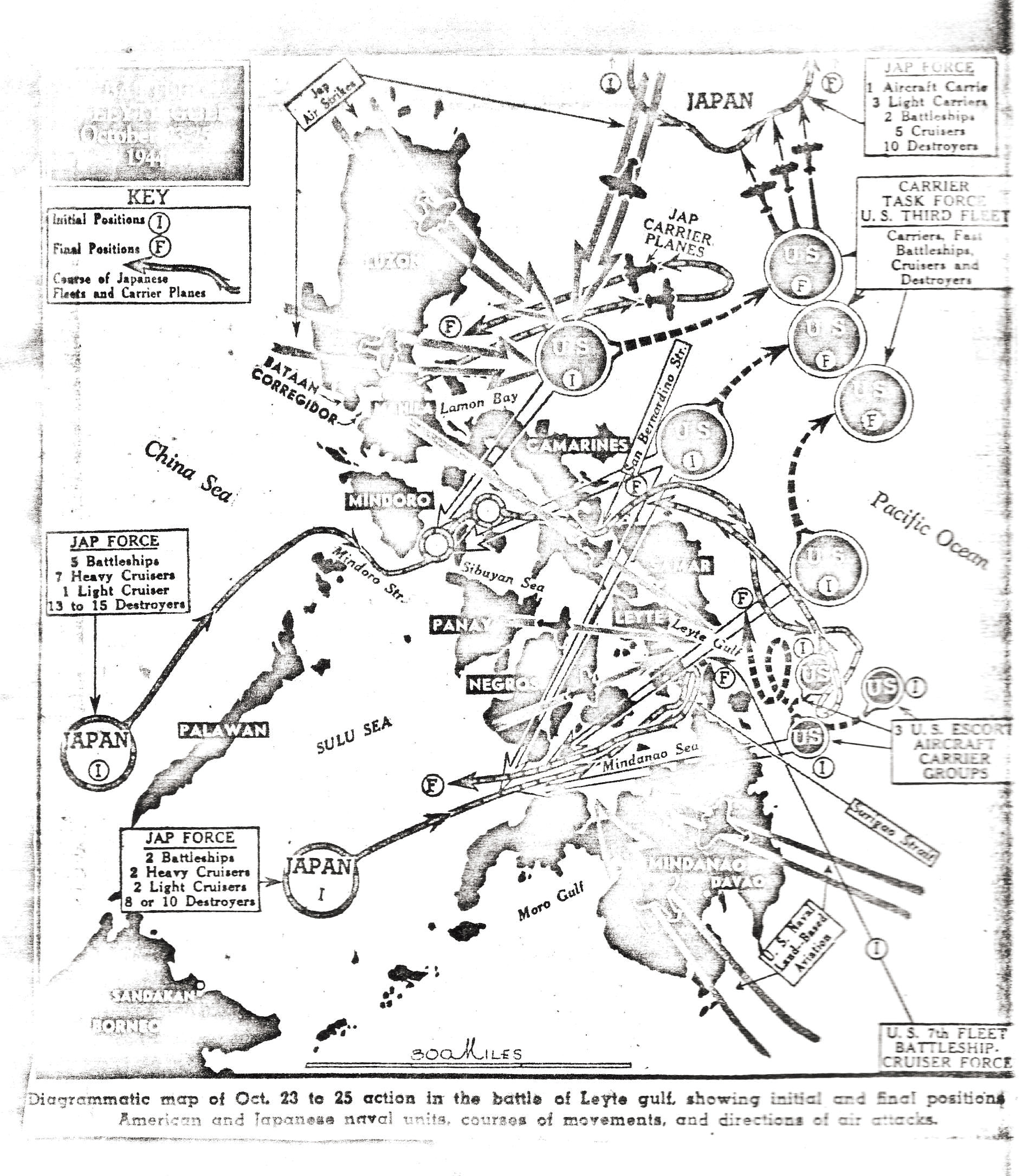
Overview of the Leyte Gulf area showing US and Japan strike forces on October 23-25, 1944.

This was not a frequented area of the South China Sea due to its many hazards. The only nautical charts of this region were British, and they looked so antiquated the Darter & Dace navigators wondered if they were from the turn of the century. (They probably were; likely the ones used by the Royal Navy when they blockaded the Phillippines during the Boxer Rebellion some fifty years earlier).

All these islands in the Philippines had offshore reefs, sandbars and outcroppings of sharp rocks, with breakers up to twelve miles from the shore. The rocks were easily misidentified as ships from a distance, because of the 'wakes' they left when waves broke over them. Many of the area's obstacles to surface boats could not be seen from the air, as they were submerged beneath choppy waves. Accurate depth soundings had never been taken in many areas. The reefs and rocks caused unpredictable currents. Tropical storms, typhoons and rain squalls had been known to blow up without warning, all of which spelled doom for many ships.

Even submerged, the thin and highly maneuverable subs were not safe. Huge coral reefs of irregular shapes also filled the area, some just below the surface, and radar at the time only detected moving objects, not stationary ones. All these factors made sea travel through this area very perilous.
Grandpa's hand drawn map of the region with latitude and longitude lines helped me locate the final resting place of the Darter on satellite images that I will repost later.

Wednesday, October 12, 2022

Hugh's Service Log 10-12-1944


Service log 1O/12/44: "Attacked a large convoy, but could not get in position to fire correctly. Finally had to fire long range shots. Fired four fish and believed to have gotten four hits, each on different ships, the firing was over 6,000 yards. Considering the distance, this was good shooting. Received seven aerial bombs, but continued to chase the convoy for another day, but finally gave up. Found out that we sank one ship, and damaged the other two." - From Hugh's typewritten service diaries

I imagine it looked sort of like the painting he kept in his living room.


Monday, October 3, 2022

10-3-1944 - Darter Under Friendly Fire

On Darter's 4th and final war patrol, one notable incident in the first week of October was on 10/3/44 around 1500 hours when several friendly aircraft almost strafed the boat.
 

  The book "Cruisers For Breakfast" (written by John G Mansfield, 1981) elaborates on the incident from veteran interviews and was mentioned in my 2014 story "Miracle in the Pacific"...

"On the 3rd of October '44, the Darter and Dace were to cover the Western approach to Balabac Strait. They patrolled submerged at almost all times, due to an incident where the Darter was surfaced and a passing American plane almost bombed them. The men saw a plane with US markings, they hoped it would keep going but it turned around and came back at them. The men panicked and scrambled to get below deck as they heard the engines whine, it was diving. Someone got the bright idea of signaling with the emergency flares, using the launch tubes at the tip and the stern of the boat. But the flares were faulty and did not launch.

One of them exploded in the tube when the cord was pulled, this blew Capt McClintock off his feet and knocked him on his rear end, almost deafening another crew member standing by. The brass signal letters meant to be laid on the decks to spell messages to aircraft also pitched off the deck and were lost overboard in the rough sea. Attempts to hail the plane by radio and code were unsuccessful, and finally the American flag was brought out on deck attached to a length of pipe and waved around. The bomber was waved off at last. The radio op said the planes were talking on 2716 kilocycles. He heard them say ““...It may be an American sub...” Skipper said “You tell them you're damn right it's an American sub, and to go away, they make us nervous.”

The Seawolf, SS-197 was not so lucky. It was sunk in the same passage by an American destroyer, the USS Rowell earlier that day and went down with all hands aboard.