Header

Header

Sunday, October 23, 2022

Darter War Patrol Log: 10-23-44


Monday, 23 Oct. ’44.

0000 H Speaking to DACE; planning remainder of coordinated patrol.

0016 H Radar contact 131 degrees T, operator says “probably rain.” 

0017 H By megaphone to DACE: “We have radar contact. Let’s go”

0020 H Bearing changed to left. Operator says it is ships. Both subs closing at full power. Come to normal approach course, 040 degrees T.  Targets headed up to PALAWAN PASSAGE.

Between now and dawn sent out 3 contact reports to CTF-71, giving final estimate that ships were a task force of 11 heavy ships.  This based on their high speed and long radar ranges obtained (34,000 yards maximum); also many sweeping radars were detected.  Tracking party said that gaining attack position was hopeless due to high target speed (initial estimate 22 knots)  Blew negative, safety, ran #10 blow every 30 minutes.  Managed to average about 19 knots.  Estimates of enemy speed began to drop until finally it was 15 knots. We had them now! Enemy course 39 degrees. DARTER was to attack left flank column first, at dawn, with DACE about 5 miles up the track in position to attack starboard column.  Did not attack in darkness, as it was considered vital to see and identify the force which was probably on its way to interfere with the Leyte landing.  It was felt that there could be no radical dawn zig due to size of force and narrowness of PALAWAN PASSAGE. Targets did not zig during night.

0425 H 20,000 yards dead ahead of port column of heavy ships. Slowed to 15 knots. Biggest pip in port column was last ship. Picked it as target.

0452 H Manned battle stations.

0500 H Targets spread by up to 16 knots.

0509 H Reversed course, headed towards port column, and submerged. (DACE had just passed us to dive to Northeast)  DARTER planned to attack from West in half light at dawn at 0540.

0517 H Now light enough to see shapes through ‘scope. We were dead ahead of port flank column of heavy ships.  Could not yet identify ships. Visibility better to east where battleships and cruisers could be seen several thousand yards away.  Two destroyers noted to east. Both drawing left. There was no echo ranging.

0525 H Making ready 11 tubes, depth 10 feet.

0527 H C/c right to parallel column to be able to fire all ten tubes. Still looked like “down the throat” shots.  First four ships in column identified as heavy cruisers. Fifth one is probably a battleship.

0528 H Range 2880 yards to first cruiser in column. Angle on the bow still small.

Monday, 23 Oct. ’44 Cont’d.

0530 H Targets zigged in a “ships left” to course 350 deg. T. Got new setup.

0532 H Commenced firing bow tubes at leading cruiser. Using periscope spread to cover 150 degrees of length.  Average range 980, gyros 35-70 right, track 92-130 starboard.  After firing two into him and one spread ahead, target was rearing by so close that we couldn’t miss so spread the remainder inside his length. Swing hard left to bring stern tubes to bear while getting setup on second cruiser.

0533 H Torpedoes started hitting first cruiser.  Five hits. Commenced firing stern tubes at second cruiser; average range 1525, gyros 50 to 60 degrees (130 deg. Left to 120 deg. Left)  Track 90-100 degrees starboard. Spread torpedoes over center 3 quarters of his length since hits in first one showed the dope was good. Whipped periscope back to the first target to see the sight of a lifetime: cruiser was so close that all of her could not be seen at once with periscope in high power. She was a mass of billowing black smoke from number one turret to the stern. No superstructure could be seen. Bright orange flames shot out from the side along the main deck from the bow to the after turret.  Cruiser was already going down by the bow, which was dipping under.  #1 turret was at water level.  She was definitely finished. Five hits had her sinking and in flames. It is estimated that there were few if any survivors.

0534 H Started deep. Evaded on base course 220 deg. T.

0534 H+ Four hits in second cruiser. Felt certain that four hits would sink this one too.  The fourth hit was 25 seconds later than it should have been. This fourth one may have hit the third cruiser, since they were now in line of bearing formation.  Attack position: Lat. 09-23N; Long. 117-11E.

0539 H Depth charge attack began. Four Dog Dogs were echo ranging and milling about overhead.  The hits, and the screws of many heavy ships probably confound the sound situation for the enemy, since the attack was not accurate.

0540 H Commenced hearing breaking up noises on sound gear on a broad bearing (roughly 340 T) where our targets should be stopped. Noises could be heard through hull in all compartments. These increased in intensity until they seemed to be right overhead and shook the ship violently. (Bearings of bucking and crunching noises only could be obtained. Heavy rumbling and explosions were too violent to get sound bearings on.)

0550 H Heard four distant torpedo explosions in rapid succession. Probably DACE firing. The Japs must think our submarines are everywhere at once. From 0600 to 0604 there were tremendous explosions. Probably magazines. It is estimated that from 0600 on, our target’s breaking up noises combined with those of DACE’s target.

0605 H Depth charges began again. Probably meant for DACE this time A total of about 36 overall were heard from this time on more distant breaking up noises and distant rattling explosions (not depth charges) could be heard until about 0625)

0630 H Last of depth charges. Four destroyers could be heard echo ranging. Estimated composition of the task force as follows: left flank column: four ATAGO class CA’s plus one possible BB. Right flank column: 2 CA’s, one BB.  Asterna nd right flank, 2 CA’s or CL’s and one CV or BB. In addition estimate six DD(only four seen). Total 11 heavy ships, 6 DD.

0820 H At periscope depth: One Atago class cruiser sighted bearing 019 deg. T, range 12,000 yards, at our attack position, listing slightly to starboard and dead in the water. No steam up. Three destroyers were near him and three planes circled the vicinity. No smoke coming from cruiser. (This cruiser was of the CA 9 and 10 stage class with catapult forward of mainmast)
The following in conenction with the damage inflicted on this attack is submitted:

  1. Leading cruiser was seen to be afire and sinking with 5 hits.

2.4 more hits were obtained, at least 3 in second cruiser; the 4th hit was 25 seconds late. Timed about right for #3 cruiser.

3.Before returning to periscope depth we were convinced we had sunk two.

4.DACE saw two cruisers burning before she attacked her column.

5.Our cripple was NOT afire at 0820. It is believed that large oil fires could not be put out in 2 1/2 hours.

  6.Three hits should sink our second cruiser.

  7.Conclusion: There is a possibility that two were sunk and one damaged. As stated this is only a possibility, yet the idea is submitted; because, unless Jap cruisers can take more punishment than ours, it is the logical explanation of the above.

0900 H Secured from battle stations, feeding crew, and making reload preparatory to attacking again.

0930 H One destroyer shoved off to North. It is believed he had been picking up survivors.

1100 H Started in towards cruiser.

1200 H Battle stations, rigged for depth charge.

1300 H Range to cruiser 8000 yards. Coming in on 90 port track. Two destroyers patrolling on beam at range 4000 yards from target, the maximum range at which we could fire.  Four planes circling overhead. Decided we would never get to fire from beam with DDs where they were, so commenced working around to bow for small track.

1430 H Range 7000 yards to cruiser. Coming in on port bow of target for small track when destroyers both headed towards us. When range about 3500 yards on closest DD, and still coming in went deep and evaded. Could not attack destroyers since our six torpedoes were for the cruiser. Decided to wait until tonight when combined attacks of DARTER & DACE would outlast the destroyer. (It should be remarked here that we were twice today well within the low power (Mk 14) torpedo range of the stopped, 657 foot target; but these are no longer manufactured in quantities sufficient to give more than a partial load to any boat.)

NOTE: LOW POWER TORPEDOES DEFINITELY WOULD HAVE MEANT ONE MORE HEAVY CRUISER ON THE BOTTOM.

1500 H Cruiser seen hoisting out a boat. He must have some steam now.

Sunset Too close to cruiser to surface for star sights.

1915 H Surfaced. Cruiser in sight on radar. Proceeding to rendezvous with DACE. Sent contact report on stopped CA and estimated composition of remainder of force.

2100 H Cancelled rendezvous with DACE not yet sighted. And reduced visibility rendering immediate attack appear favorable. DACE ordered to take attack position 10 miles bearing 150 deg. T from cruiser. DARTER 10 miles bearing 050 deg. T from cruiser. (Thought DDs would attempt tow cruiser in our direction towards PALAWAN BARRIER REEF)

2200 H Cruiser underway, course about 220 deg. T. Speed varied from 4 to 5 knots; course was erratic as though target was steering with screws. One DD patrolling on each beam.

2245 H Started in for surface attack in very poor visibility. Planned to attack from Stbd. Quarter, coming in last mile slowly on battery. Told DACE we would attack in 90 minutes and to sink him if we were forced down.

2306 H Radar detector picked up two radars sweeping. Decided against surface attack. Told DACE to attack when ready, DARTER ending around to starboard for attack at radar depth. Ending around at range 15000 yards on target.

2310 H We now began running through heavy fuel oil slick from the morning attacks. Slick seen and heavy fumes noted for next 45 minutes.

2400 H About one hour to run to gain attack position ahead. Range to cruiser about 18000 yards. Making 17 knots. (Had no sights for 30 hours.)

10-23-1944 - The Fleet Counterattacks


October 23, 1944 ~0540 Hours

The men anxiously pleaded for a look in the periscope, but McClintock chose to describe what he saw instead. He said the whole first cruiser was on fire and trailing dense billows of black smoke from the forward turret to the stern. It looked like a fireworks show coming out of the boiler smokestack. The cruiser was driving fast as if they were escaping, but it was plowing beneath the water and the bow was already submerged, the first turret was going under. He wondered if its engines would keep propelling it straight to the bottom.

A call came from the forward torpedo room. “Five hits out of six!” The sub echoed with shouts and war whoops. Men were slapping each other on the back in congratulation. The Skipper came over and personally thanked the radar crew for the contact that led to the hunt of a lifetime.
 
Darter had done her job, and a spectacular job at that. Now it was Dace's turn.
 
What followed was the sound of more explosions as the Dace scored her hits on the fleet ships, which were now turned and high-tailing it out of there. The crew heard a crinkling sound through the hull, like beer cans being crumpled in a trash compactor. Over the next few minutes it grew to a staggering volume, so loud the men had to cover their ears. 
 
These were the sounds of the doomed ships breaking up and being crushed as they went down. Veterans would describe it as a horrible shrieking, tearing sound, like fingernails on a chalkboard magnified a hundred times. Muffled thuds were heard as some softer objects fell on the sub from above, no one wanted to talk about what those were. Then there were shock waves from more explosions that rocked their tiny boat. These must have been the fires lighting the ammo magazines.
 
Hugh peered into his radar scope, the only link to the outside world available to him, as he watched a big blip on the screen disappear when the ship went under. The Skipper at the 'scope wouldn't describe the huge fireballs that he saw, but he mentioned that the enemy ships must be shooting in all directions in a panic. The tracers from shells were flying out like sparks, and the destroyer turrets were firing at the open sea, trying to scare away the unseen attackers as the cruisers drew in closer to the main force. They knew it was only a matter of seconds until the depth charges would be rolled out.
 
...Surely enough, it began. They heard the unmistakable muffled splashes of heavy metal drums hitting the water, and then silence. The sonar picked them up, and started to ping. The sound wave returns became closer and closer together, and men all over the sub visibly began to sweat. They were close.
Depth charges were another terrifying matter altogether, because nothing is more helpless than being trapped in a closed steel tube with metal drums of explosives raining down on your fragile boat. Direct hits were unnecessary; the force from the shock waves alone could shake a sub apart or turn the men inside into mincemeat.
 
After a few long seconds of eternity...the first rupture. This one was muffled. The next one burst just a bit closer, and louder. A few more bursts in quick succession, these sounded almost like knocks. The angel of death was knocking on the outer hull. A young sailor, in a panicked voice, said “For the love of God, somebody let that man in!!” Everybody jumped as each one grew louder than the next.
 
For the next few minutes, the tiny vessel felt like it was inside a giant paint mixer. The vibration from the shock of the bursts was almost continuous. The men lost count, but it had to be around thirty charges strung together. About one explosion every two or three seconds.
 
One cannot imagine the utter Hell that occurred inside the sub. Men were tossed about, rebounding off walls like rubber squash balls. Lights flickered and bulbs shattered. Leaks sprang up. The lights and gauges on the instrument panel couldn't be made out, the boat shook so violently. A few glass dials shattered, sending splinters of glass flying. 
 
The men shut their eyes, gritted their teeth and rode it out. Showers of sparks sprayed out of the control panels. All they could do was hold on to something for dear life. The hull of the sub seemed to bend and twist. The men's hearts were pounding like the depth charges relentlessly pounding on the hull.
Another minute or two of the devil's grip trying to break the helpless boat in half, and then it abruptly stopped. It was over. The sub was tilted slightly from the shock of a last close one, then it righted itself.
Dave ordered ahead full on batteries, and they outran the last of the depth charges and sped away silently. He told everyone to sound off, to make sure no one was seriously hurt. He heard 79 voices say their last names. Nobody was unconscious. Amazingly, they were all still alive. Well, what a small price to pay for having sunk one ship and crippled another.
 
Nobody on the sub knew it yet, but they had sunk the cruiser Atago, and most of its crew was on their way to the bottom. Admiral Kurita was picked up by one of his own ships a few hours after dawn. He was alive, but very cold and wet and was none too happy. The cruiser Takao, heavily damaged and smoking, was limping on with the rest of the fleet as sailors tried to get her boilers going and her deck fires under control, and Darter knew she would have to go back and finish off her prey.
 
But the Dace and Darter had fulfilled their mission, and started the most epic sea battle in history with a shot heard around the Pacific.
 
--Miracle In The Pacific, by J.D. Batt. 2012
 
references:
-Battle Stations Submerged by R.C. Benitez
-Cruisers for Breakfast: War Patrols of the USS Darter and USS Dace by John G. Mansfield. 1981
-4th War Patrol Logbook of Darter SS-227 transcribed by Hugh Siegel
-Silent Service: Two Davids and Goliath. California National Presentation, 1952 film


10-23-1944 - The Attack Begins


October 23, 1944 - Balabac Strait, Philippines

Aboard USS Darter

Ship's time: 0510 hours. It was very close to daylight now. Darter battened down the hatches, went below the surface again, and rigged for silent running. The chase had begun.

Darter would strike first. Her shots would spread out into a fan pattern that would decimate the unsuspecting left side, and then as the right side altered course to evade, they would swing right into the crosshairs of Dace. It was a perfect trap, and there was no escape for their prey. They called these submarine teams wolf packs for a reason. The excitement in the control room was approaching a fever pitch. Captain McClintock was visibly excited. “We've got them now!” His emphatic statement only echoed the thoughts of the vigilant and superbly trained crew around him, his brothers and shipmates.
The hunted had just become the hunters. Darter and Dace were going to war by themselves...to save the Allied Philippines invasion effort. It was a harebrained idea, but that was the genius of it. Who would suspect such a suicidal attack by two tiny subs? Alone, unsupported and hopelessly outgunned by the largest, most heavily armed Navy ships in the history of the world? It was David McClintock against Goliath.

According to the navigator, the weather was clear. The wind was blowing at 55 degrees bearing at three miles an hour, the ocean was very calm, 40 kilometers visibility. 3 Sunrise was set for 0559, and it was getting brighter already. The Skipper described the view of the fleet spread out in front of them through the 'scope as "like a grey city on the horizon.” 
 
They were spread so far, he had to swivel the periscope to look at them all. They were getting close enough he could make out battleships, cruisers and destroyers, they appeared to be zigzagging a bit judging by their wakes. The enemy must know they are being followed. Still no depth charges yet. Everyone aboard could only imagine the fear and anxiety of the sailors on those ships. Every piece of floating debris probably looked like a periscope to the deck watchmen. As it was, the hairs on the backs of the men aboard the Darter were sticking up, everyone had a prickly sensation down their spine. The air was electrified by tension.
 
McClintock kept the intercom from the conning tower open, so everyone below could hear how it was going. “Angle on the bow increasing...55....60. 65. Range, under one thousand yards. Shooting bearing...Mark! FIRE ONE!”
 
The torpedo gunner pushed the first fire button, which lit up red to indicate it was away, but everyone on board knew it. The ship lurched back and forth, and a loud buzzing was heard that decreased in pitch and faded away as the deadly 'fish' sped away toward its target. They waited a few seconds and then launched another five torpedoes, in quick succession. Six sleek and deadly missiles were whirring away into the murky sea.
 
He shouted that the first cruiser appeared to be turning away, so they targeted the second one. Range, fifteen hundred yards, the command came echoing back. The dials on the mechanical computer spun and the numbers matched up, they had their fix. They fired another two fish. Now they had caught up, they were traveling perfectly parallel to the fleet's direction of travel, and were right in the middle of the cluster of ships.
 
McClintock ordered “Rudder hard to Starboard! Fire stern tube number one!” The ship lurched again, tossing everyone about as loud explosions reverberated through the tiny sub. “Depth charges!” shouted a panicked voice from somewhere. Dave shouted over the roar. “Depth charges, hell! Torpedoes!” They were so loud and close to the ship, it indeed sounded like depth charges were raining down on them.
The gunnery torpedo officer must have been punching one torpedo button after another and jumping up and down excitedly as he heard each hit. They heard the sound of his boots stamping on the conning tower floor above their heads. The sounds over the radio from Dace were excited as well, he thought he heard cheers and applause. He marked the time: 0532 hours.
 
Darter had fired the first shots. The Battle of Leyte Gulf had begun.
 
--Miracle In The Pacific, by J.D. Batt, 2012
references:
-Battle Stations Submerged by R.C. Benitez
-Cruisers for Breakfast: War Patrols of the USS Darter and USS Dace by John G. Mansfield. 1981
-4th War Patrol Logbook of Darter SS-227 transcribed by Hugh Siegel
-Silent Service: Two Davids and Goliath. California National Present#dartermonth2022

Saturday, October 22, 2022

Darter War Patrol Log 10-23-1944


Just after midnight on October 23rd, the Darter located the rear destroyer escorts of the entire Japanese fleet bound for Leyte. #dartermonth2022

Official USS Darter War Patrol Log
Monday, 23 Oct. ’44.

0016 H Radar contact 131 degrees T, operator says “probably rain.”

0017 H By megaphone to DACE: “We have radar contact. Let’s go”

0020 H Bearing changed to left. Operator says it is ships. Both subs closing at full power. Come to normal approach course, 040 degrees T. Targets headed up to PALAWAN PASSAGE.

Between now and dawn sent out 3 contact reports to CTF-71, giving final estimate that ships were a task force of 11 heavy ships. This based on their high speed and long radar ranges obtained (34,000 yards maximum); also many sweeping radars were detected. Tracking party said that gaining attack position was hopeless due to high target speed (initial estimate 22 knots) Blew negative, safety, ran #10 blow every 30 minutes. Managed to average about 19 knots. Estimates of enemy speed began to drop until finally it was 15 knots. We had them now! Enemy course 39 degrees. DARTER was to attack left flank column first, at dawn, with DACE about 5 miles up the track in position to attack starboard column. Did not attack in darkness, as it was considered vital to see and identify the force which was probably on its way to interfere with the Leyte landing. It was felt that there could be no radical dawn zig due to size of force and narrowness of PALAWAN PASSAGE. Targets did not zig during night.

0425 H 20,000 yards dead ahead of port column of heavy ships. Slowed to 15 knots. Biggest pip in port column was last ship. Picked it as target.

0452 H Manned battle stations.

Friday, October 21, 2022

Darter War Patrol Log - Oct 21, 1944

Saturday, 21 Oct ’44.

0000 H Picked up news broadcast on Phillippines invasion.

Immediately headed for BALABAC STRAIT to watch for heavy units since SINGAPORE-BALABAC-MINDANAO SEA is shortest route for any part of Jap fleet which might head for LEYTE.

0815 H Submerged in western approach to BALABAC STRAIT.

1824 H Surfaced. Patrolling tonight covering southwest approaches to BALABAC STRAIT.

2350 H Radar contact 26,000 yards, 261 degrees T(3 targets) 0100 target position 07-31N; Long. 115-22E.
 
2352 H At battle stations; making full power. Sent contact report to DACE and CTF-71 on 3 probable heavy cruisers. Targets tracked at speed 23 knots, base course 020 degrees T, headed through the Dangerous Ground. We were only 29 degrees forward of targets from beam on contact, and never had a chance to gain position. Held on at full power (18.8 knots) through Dangerous Ground until after daylight with view (1) possible zig toward us (2) to send out contact reports to coach DACE onto track (3) to attempt to sight targets at dawn for identification. Sent total of two contact reports to CTF-71 and 11 to DACE. DACE was in position for possible interception.

Thursday, October 20, 2022

10-20-1944 - Invasion of Leyte Began


On October 20 1944, the sailors heard on the radio that the invasion of the Philippines had begun. General MacArthur had landed his Marines on Leyte Island. It was only at this point that the crew of the Darter and her sister boat the Dace learned why they were on patrol in this area. They carried out their orders silently and never questioned why. If Sub Command told them to go somewhere, they went. Being isolated and alone on the open sea, it was easy to forget that there was a war going on as each man was fighting his own private war against boredom, fear and anxiety, with the endless routine of diving and surfacing and false alarms.

The role of Task Force 'M' was now clear. Their mission was to patrol the Palawan Passage in an area known as the "Dangerous Ground", and set a trap for Japanese ships passing through on their way to interfere with the Leyte landings. They were trying to 'interfere with the interference', as it were. Just two mice setting a trap for an elephant. Sounded simple on paper. But this was easier said than done.
The area they had to patrol was huge; hundreds of square miles of open sea, and they were just two tiny subs. They would be considered the forward picket line. If the Japanese fleet passed through, both submarine crews knew they would have the best chance at getting the first shot and strike a decisive blow that could start an epic battle in the Southwest Pacific. But there was also a constant fear the fleet would spot them first, all it took was one airplane and they would be in trouble. Due to the secrecy of submarine operations, no one else knew where they were. They were not allowed to contact their own fleet. They were alone and no help would come.

Which boat would be the lucky one to spot the enemy first? Only time would tell...

Tuesday, October 18, 2022

Darter in Palawan Passage - "The Dangerous Ground"


The area of the South China Sea off the coast of Mindanao, between Brunei Bay and Palawan Island is named the Balabac Strait, otherwise known as the Palawan Passage. On nautical charts during the war, this was referred to as the Dangerous Ground. This is where the USS Darter found herself on her fourth war patrol as she lay in wait for the Japanese fleet to arrive, the week of October 20th in 1944 .


Photocopy of a nautical chart of the Philippines, including known seafloor depths and currents

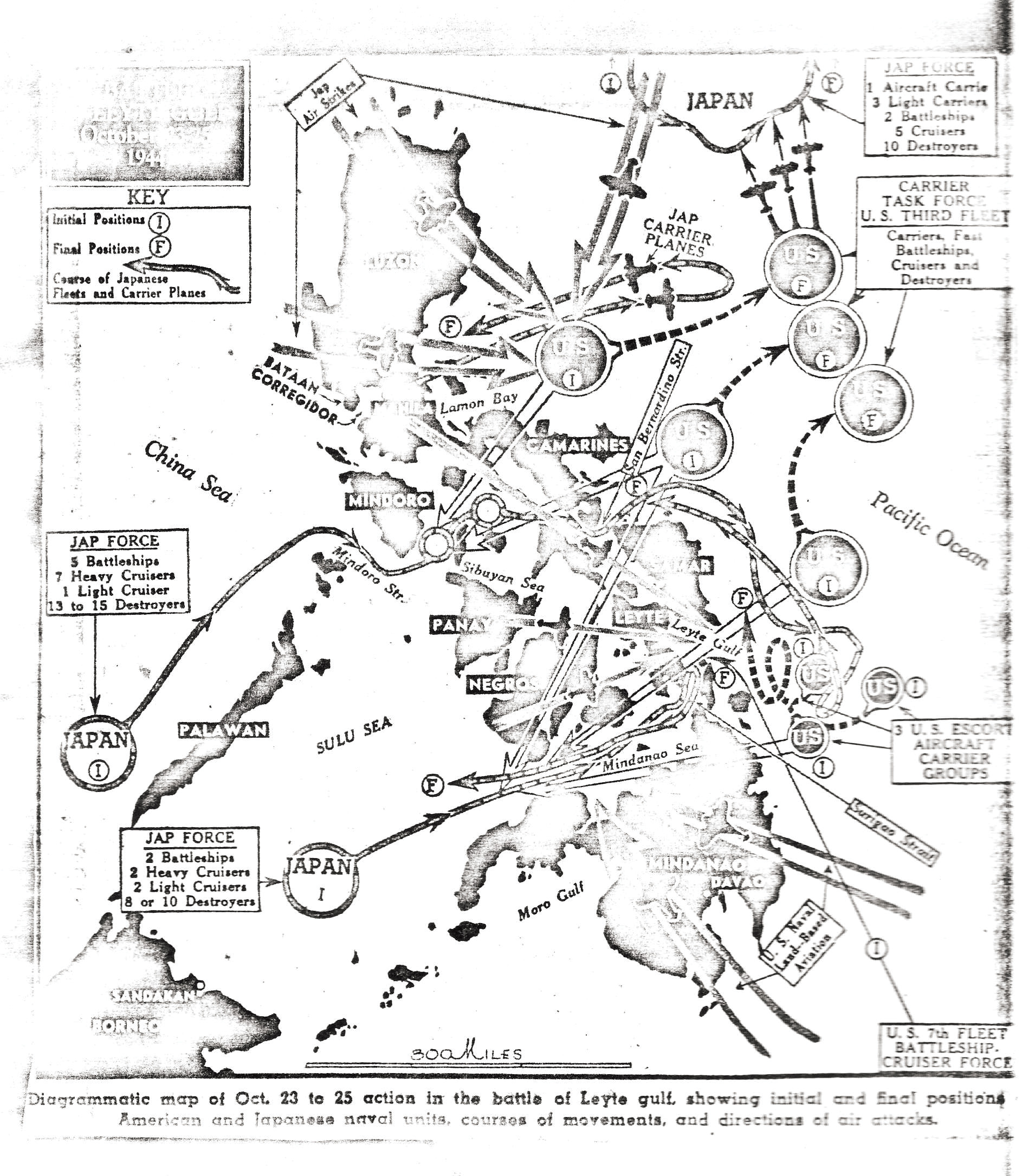
Overview of the Leyte Gulf area showing US and Japan strike forces on October 23-25, 1944.

This was not a frequented area of the South China Sea due to its many hazards. The only nautical charts of this region were British, and they looked so antiquated the Darter & Dace navigators wondered if they were from the turn of the century. (They probably were; likely the ones used by the Royal Navy when they blockaded the Phillippines during the Boxer Rebellion some fifty years earlier).

All these islands in the Philippines had offshore reefs, sandbars and outcroppings of sharp rocks, with breakers up to twelve miles from the shore. The rocks were easily misidentified as ships from a distance, because of the 'wakes' they left when waves broke over them. Many of the area's obstacles to surface boats could not be seen from the air, as they were submerged beneath choppy waves. Accurate depth soundings had never been taken in many areas. The reefs and rocks caused unpredictable currents. Tropical storms, typhoons and rain squalls had been known to blow up without warning, all of which spelled doom for many ships.

Even submerged, the thin and highly maneuverable subs were not safe. Huge coral reefs of irregular shapes also filled the area, some just below the surface, and radar at the time only detected moving objects, not stationary ones. All these factors made sea travel through this area very perilous.
Grandpa's hand drawn map of the region with latitude and longitude lines helped me locate the final resting place of the Darter on satellite images that I will repost later.