 |
| U.S. Navy sailors doing open order M1 rifle drill, presenting before an unidentified officer. Undated photo from Hugh's collection. Most likely in Australia. |
Header

Monday, March 23, 2015
Historical Image Archive

Friday, January 2, 2015
The DARTER Submarine II (SS-576)
 |
| A Navy publication photo of SS-576, taken sometimes in the 1970's. |

Since her construction, DARTER (SS-576) has continually undergone modernization and conversion to make her performance comparable to the newest submarines of her type.
The new DARTER has been homeported at New London, Connecticut; Charleston, South Carolina; San Diego, California and most recently Sasebo, Japan. She has seen service in the North Atlantic, the Mediterranean, the Caribbean, and the Western Pacific.
Statistically, the new DARTER is 285 feet long, has a beam of 27 feet, displaces 2,050 tons, and is propelled by diesel-electric drive through twin propellers. Her complement is 75 men and 3 officers."
The new USS DARTER remained in service through 1981, a career spanning almost 30 years. There is a letter dated 1981, in which the Skipper of SS-576 requested a copy of the famous photograph of the SS-227 aground on Bombay Shoal. Hugh personally saw to it that the SKipper obtained a copy, which was framed and kept in the officer's quarters.
The new DARTER sub was decommissioned October 6, 1989. My grandfather was invited to the ceremony and recorded a VHS video of the occasion. Maybe someday I will put this on Youtube.

 |
| A personally autographed photo of the USS-DARTER SS-576 from 1981. |
 |
| Hugh's commemorative beer stein decorated with the seal of the submarine. |
Tuesday, November 11, 2014
Veteran's Day
I will never know the full story of what you saw or what you did in service to our country, but I am grateful to be the grandson of a veteran. I will always look up to you as I always have, and honor your memory by keeping the past alive.
 Served 1942-1975
Thank you.
H.N.S. 1919-1995
Sunday, September 21, 2014
DARTER crew group photos 1943
I apologize for being lax on updating this blog recently. There is still so much left to share.
Two recently scanned photos of the DARTER crew, dated September 1943. Formal (dress blues) and informal (sailors with their girlfriends). Who knows, maybe somebody's grandparents are in this photo!


Two recently scanned photos of the DARTER crew, dated September 1943. Formal (dress blues) and informal (sailors with their girlfriends). Who knows, maybe somebody's grandparents are in this photo!
Tuesday, June 24, 2014
What did Hugh do before & after the war?
In
1941-1942, Hugh was a lens grinder who worked at a production plant for precision optics in Camden, New Jersey. His childhood friend
Jeanette, who he would later end up marrying, was a teenager and
worked as a typist and secretary in an office, also in Camden.
Hugh's parents lived on Deveraux Street in Philadelphia, and he
likely rode the train over the bridge to get to Camden. They wrote
letters back and forth and he probably saw her during this time.
Based on Jan's birth year of 1928, she would have been 14 when Hughie
enlisted. Hugh was born in 1919 and was older, he was about 23 years
of age. (He enlisted in 1942, possibly to escape the draft) He
enlisted in US Navy Reserves, not the Navy proper.
Hugh
had always loved amateur radio and electronics, tinkering with them
almost since their invention. He probably took all the radios in
his parent's house apart and put them back together as a kid, with or
without success. He got his first real radio operator's license in 1937, so he
was already a ham by the time WWII broke out. His bedroom walls were
no doubt plastered with QSL cards. His first radio call sign
assigned to him was W3GYY. Later on it became W2YAM and much later,
K2CP. In his radio room in the 1980's were boxes of vacuum tubes, a
throat mike used by fighter pilots, a couple old military radio
headsets, a primitive code practice machine that used a magnetic tape
reel recorder, and Heathkit equipment he had built and tested himself. He had an old telegraph transmitter key and receiver tapper
from the late 1800's or very early 1900's. When I was little I used
to play with a small code practice rig he had hooked up, as well as
listen to cassette tapes he had with code lessons. He used to say
that “Real radios glow in the dark!”
His
old pal Tommy George (*actually his cousin) applied for a ham license
the same day as Hugh. Hugh's call sign was K2CP and Tommy's was K2CJ.
They remained friends until well into their 70's. Both Hugh and
Tommy were licensed for over fifty years.
Hugh
remained in contact with many of his WW2 submarine veterans well into
the 1970's, '80s and '90s. He kept detailed lists of the men's
names, their last known addresses and even their radio call signs. It
may be worth contacting some of these people by mail --or their next
of kin-- to find if they are still around. The most recent veteran's
rosters I have in my possession are dated 1985 though. A lot changes
in 30 years (like me growing up for example). Still it may be worth a
shot in the dark.
I
don't know what Hugh was interested in at the time the war came to
America. I don't know what movies he liked, or what music he listened
to, or what books he read. I can only guess based on what was popular
at the time. I know he always loved books though, as he would sign
his name inside the cover of each one as “From the library of Hugh
N. Siegel”.
Hugh
was always into boats and the sea. His own father served in the Navy
around the turn of the century. Frederick Valentine Siegel was a
gunner's mate aboard the steamship USS Indiana, and he fought in the
Spanish-American war and the Boxer Rebellion. He may have given Hugh
his middle name, Nelson, in tribute to Admiral Horatio Nelson, but
this needs to be verified. So the Navy was in his blood. He always
loved fish and sea creatures, and the ocean. We have many pictures
of him at the beaches in Wildwood and Ocean City, New Jersey. As far
as I know he never surfed though. He did not seem athletic; by that
I mean he did not seem to enjoy sports. Though later in life he
enjoyed camping, backpacking, hiking and skiing. He moved to upstate
New York for this reason, to be closer to the Adirondacks.
He
enlisted and was accepted into US Naval Training School as a Radio
Tech 2nd Class because of his civilian experience. He
worked at a message desk in the Commandant's office about the same
time Jan was a typist. They could both type very well, and Hugh
later convinced Jan to get a Novice-grade ham license (listen but
code transmit only)
When he was still in training at the Navy academy, he learned that his Dad died of a heart attack on his way to a fire (he was a fireman). Then his mom died two years later. he received that telegram after arriving in Australia, having just survived the worst ordeal of his life. He went to live with his uncle George on Albion
Street.
Hugh
worked at Frankford Arsenal in Philadelphia for awhile before being shipped out.
Friday, March 14, 2014
Fourth and Final War Patrol of Darter - Official Navy History Department Entry
The following is from a typewritten copy of the ship's history of the USS Darter SS-227, specifically its last day of service during which it crippled the Japanese fleet, sacrificing itself in the process and ran aground:
Naval Records and History
Ship's Histories Section
Navy Department
HISTORY OF USS DARTER (SS-227)
Ship's Histories Section
Navy Department
HISTORY OF USS DARTER (SS-227)
(excerpt from complete account)
Commander McClintock took his sleek command out of Brisbane on her fourth and final patrol on 1 September 1944, pausing at Darwin on the 10th. Operating with USS DACE SS-247, DARTER set up a reconnaissance line to intercept any enemy forces which might interfere with the Morotai landings. On the 24th she left for Biak for replenishment and, after four days in port, headed back to her patrol area of Palawan Passage and Balabac Strait.
The two "D's" fell in with a rich convoy of seven enemy ships with only three escorts on 12 October in the center of Palawan Passage. Waiting three hours for the ships to get into position, DARTER fired four torpedoes at two overlapping tankers from 6000 yards, and then dived to escape the air cover. Three hits were heard, as planes dropped seven bombs close by without damage.
The convoy scurried into the safety of Balabac Strait, where the submarine could not follow. Sending a contact report to DACE, DARTER took up her position to await their sortie. Finally, near midnight on the morning of the 14th the ships ventured out, being spotted first by DACE. Since DACE had made the first contact, DARTER stood aside to let her make the first attack, seeing her make four hits. By this time, the convoy made it into Kimanis Bay, with the destroyers effectively blocking any chance for further attacks.
The two subs then took up a patrol in Palawan passage, and on the 18th switched to the west approaches to Balabac Strait. Their vigilance was rewarded on the morning of the 19th when two destroyers approached, and DARTER found herself between the two. She fired four stern tubes at one, but missed her entirely when a turn threw the torpedo track off. The ensuing depth charges did no damage.
As the 21st opened, the radio brought news of the invasion of the Philippines, and immediately the two submarines headed for Balabac Strait, hoping to catch Japanese heavy units from Singapore since the shortest route to the landing beaches lay through the Strait and the Mindanao Sea. Just before midnight the first enemy warship came into view, three heavy cruisers headed through the Dangerous Ground making 23 knots. After six hours the pursuers were 19 miles behind, and so they broke off, heading south to intercept any other units.
The two subs were cruising along close together on the surface, recharging their batteries, when DARTER made radar contact on a group of fast surface ships at 16 minutes past midnight. Grabbing a megaphone, the captain of DARTER shouted to DACE, "We have a radar contact. let's go!"
Calling for full power, both ships were soon making 19 knots in hot pursuit of the enemy force of eleven heavy ships, headed up Palawan Passage. The enemy warships were making 22 knots, but soon slowed to 15, and soon an attack was worked out. DARTER was to have first choice, hitting the left flank column at dawn. USS DACE took up a position five miles ahead to attack the starboard column. Since the channel was narrow, the submarine skippers were reasonably sure that there would not be a large course change during the night.
DARTER ran ahead for 20,000 yards, and picked out the leading enemy cruiser as her target. Although neither submarine knew it, the force they had contacted included the two largest warships in the world, the secret Japanese super-battleships YAMATO and MUSASHI, both of whom boasted 18.1-inch guns in their main batteries.
The attack was ridiculously easy. Diving to periscope level, DARTER worked her way inf or a clear shot at the leading cruiser in the port column, and at 0532 began firing. The first three torpedo tracks were spread in order to take care of any unexpected maneuvers of the big ship, the heavy cruiser ATAGO. By the time that the next three were ready to fire, ATAGO was roaring by so close that the deadly missiles couldn't miss, and so they were fired straight into its length.
Wasting no time, DARTER swung hard to bring her stern tubes to bear on the second cruiser, and as she did so heard the satisfying roar of five explosions. Firing her stern tubes, Commander McClintock swung his periscope back on the "sight of a lifetime," ATAGO lying dead, a mass of billowing black smoke from her #1 turret to the stern. Bright orange flames licked out along the water's edge as the bow began to go under. To add to the crew's joy, four more hist sounded through the submarine as four of the torpedoes struck the second heavy cruiser, TAKAO.
Retaliation began within five minutes, but none of the depth charges came close, although the breaking-up noises from the cruisers were so loud that it seemed that they must be sinking directly overhead.
DACE got off her first attack, and at 0557 the submariners in DARTER could hear four more hits. DACE had eliminated the heavy cruiser MAYA from the Japanese register.
When the depth charging slacked off, DARTER tried to get int o finish off TAKAO, but was unable to get in past the destroyers. Since the Japanese were so close, the submarine could not surface to get an accurate navigational position, and was forced to cruise submerged until nightfall.
TAKAO managed to get underway erratically by 2200, and DARTER started in on the surface to finish her off, but intercepted radar signals caused her to delay, and she went under, running at full speed to get into position.
Suddenly the radio operator on board DACE was electrified by a radio message from DARTER in plain English, "Hard aground." DARTER, running submerged at 17 knots, had hit Bombay Shoal. It had been 30 hours since she had been able to get a good position, having been running on a dead reckoning chart during the whole attack.
The submarine shoaled at 0005 hours, and between then and high tide at 0146 the crew worked feverishly, destroying all confidential matter and dumping everything movable overboard in an effort to lighten the ship. For an hour after the full tide, they worked to get free, but nothing helped. With sunrise expected momentarily, it was decided to abandon the ship, sending the crew aboard DACE, who was standing by.
Demolition charges were planted, and as soon as the last man was safely on board DACE, they were set off. For some reason, however, they failed to explode properly, leaving the submarine in good condition for any Japanese studies. DACE then opened fire with her deck gun, putting 21 hits into DARTER along the waterline before a plane forced her to dive.
A Japanese destroyer then appeared, and may have boarded the sub. The submarine ROCK tried to complete the job of firing ten more torpedoes later, but again the torpedoes went off before hitting the target. NAUTILUS finished the job of destruction on the 31st with 55 six-inch hits.
DARTER's loss was a result of a calculated risk, one of the tactical losses which must be expected in wartime. Her loss was well balanced, however, by the discovery of the Japanese task force and loss of two cruisers sunk and one badly damaged. In order to keep the entire crew together, all of the men on board DARTER were ordered to take over the new submarine MENHADEN, then building at Manitowoc, Wisconsin.
USS DARTER earned four Battle Stars on the Asiatic-Pacific Area Service Medal for participating in the following operations:
1 Star: Truk Attack -- 16-17 February 1944
1 Star: Battle of Surigao Strait -- 24 October 1944
1 Star: Submarine War Patrol -- 22 March - 23 May 1944
1 Star: Submarine War Patrol -- 21 June - 8 August 1944
The ship also received the following Navy Unit Commendation, Pacific, for her Fourth War Patrol:
"For outstanding heroism in action during a War Patrol against enemy Japanese Fleet units. Aggressive and relentless in tracking her targets, the USS DARTER daringly penetrated hostile waters and succeeded in contacting a Japanese task force. In an excellently planned and brilliantly coordinated attack, she opened fire. As a result of these salvos, launched boldly by the DARTER despite the superior fire power of the hostile concentration, the enemy was forced to retire, thus reducing appreciably the enemy's naval strength subsequently brought to bear against our forces. The splendid combat readiness of the DARTER and the gallant fighting spirit of her officers and men throughout this hazardous action reflect the highest credit upon the United States Naval Service."
Compiled: July 1953
Sunday, March 2, 2014
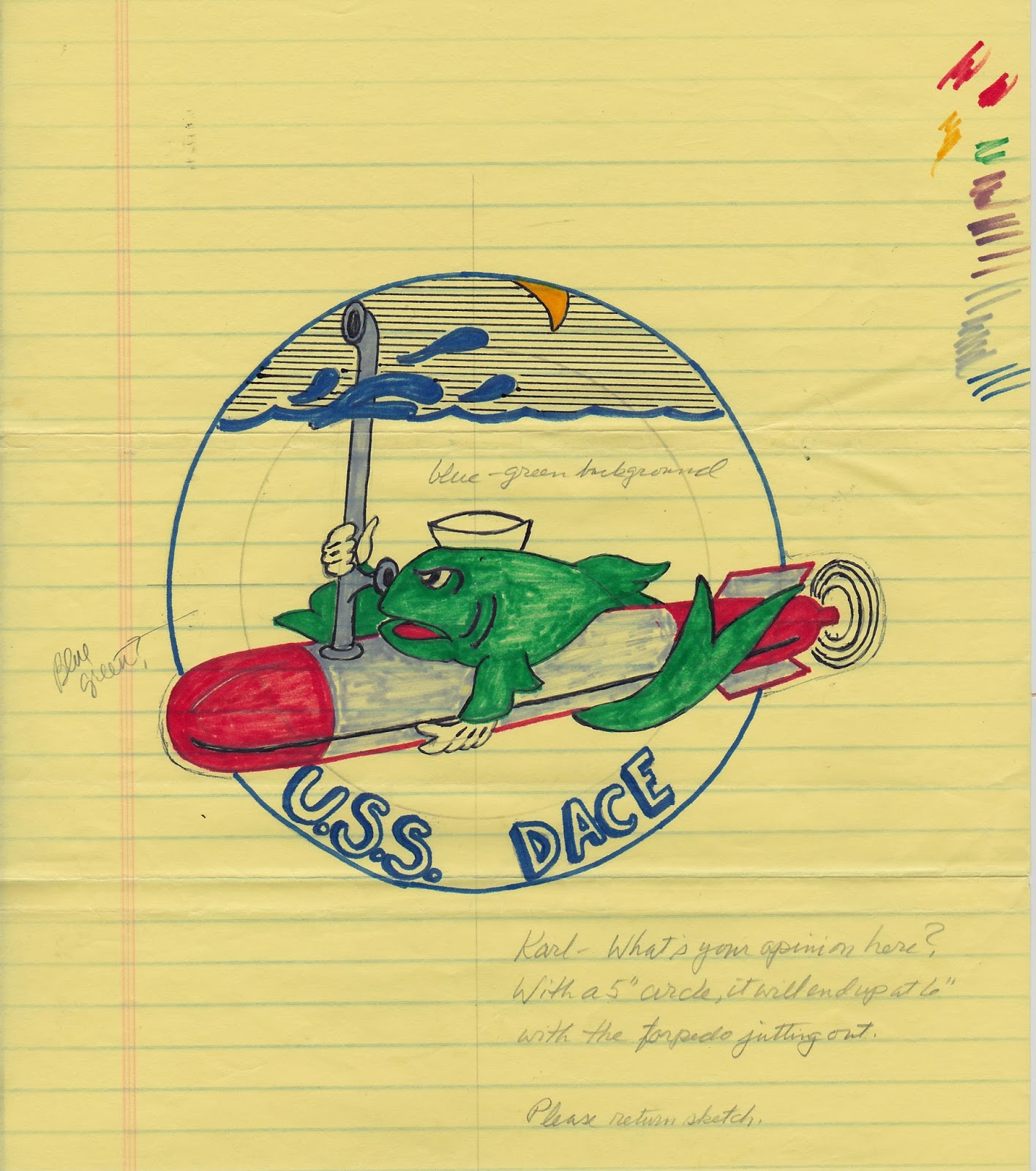
USS Dace Service Patch Design
It appears Hugh also designed the patch for the Darter's sister
submarine, the USS Dace....or at least the veterans patch for it. I have
his sketches and concept artwork, and this is pretty
awesome.
You can obviously see who I inherited my design skills from.


 |
| Here's the printed logo as it appears in WWII Sub Vets publications. |
Now, below is also another cool logo Hugh has copies of. It was for his replacement boat, the USS Menhaden he served on after the war. This is a silk screened version of it from the 1950's.
I do not think that he designed the Menhaden logo, as it was already in use by the Navy. It appears on a dinner menu from a meal served aboard the submarine, so it is unlikely that he designed it. I don't have any concepts for this one, only the finished design.
I think he just asked for a copy of it because he liked it.
Subscribe to:
Posts (Atom)